How to Price a Freelance Project Without Forgetting Costs
A project quote should pay for the work, the costs of delivering it and the risk that the scope changes. If you only multiply your expected hours by an hourly rate, a busy project can produce very little profit. Here is a simple way to build a quote you can explain to a client.
1. Define the deliverable before the price
Write down what the client receives, the number of revisions, the files or handover, and what is outside the scope. Separate discovery, production, review and delivery. A quote based on a vague brief is difficult to defend when new requests arrive.
2. Count all the working time
Include meetings, research, production, testing, revisions and administration. For a fictional project, suppose the total is 20 hours and your target labour rate is CAD $60 per hour. The labour component is CAD $1,200. This is an example, not a recommended market rate.
3. Add direct costs and selling fees
Suppose you expect CAD $120 in project-specific costs and CAD $60 in platform or payment fees. Your working cost is now CAD $1,380. A CAD $1,200 quote would fail to cover those assumptions, even though it appears to pay for the 20 hours.
4. Price for uncertainty deliberately
Build a reasonable allowance for likely revisions or extra coordination. If you add a CAD $150 buffer in this example, the planning total becomes CAD $1,530. Decide whether to include it in a fixed price, limit revisions clearly or offer a separately priced change request. Do not present a buffer as a guaranteed expense.
5. Check the quote before sending
- Does the price cover your estimated time and direct costs?
- Are platform fees and payment processing accounted for?
- What happens if the client asks for one more revision?
- Is the timeline realistic alongside your other commitments?
- Do the deliverables and payment milestones match the proposal?
Taxes, currency conversion and platform fees vary by situation. Check the applicable rules and your actual fee schedule rather than copying someone else’s percentage.
Turn the calculation into a clear proposal
Give the client a concise scope, price, timeline, revision limit and next step. Keep your internal calculation so you can learn from actual hours after delivery. Over time, comparing planned and actual effort will make future quotes stronger.
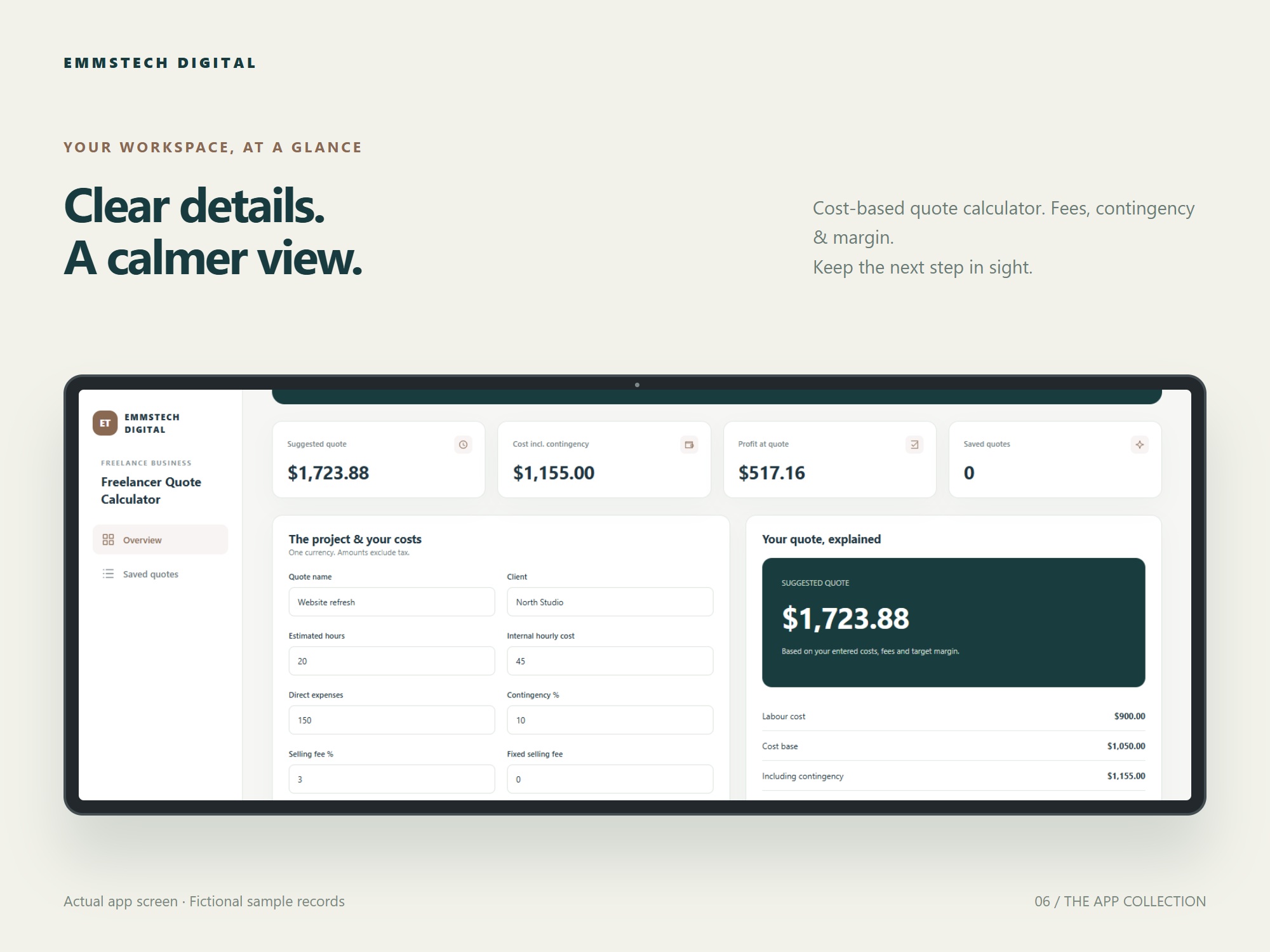
Try it with your own numbers: the Freelancer Quote Calculator helps you estimate project costs, fees and target profit in an offline browser app. Review the assumptions and tailor the final quote to your work and client.