How to Test a Business Acquisition Before You Buy
Buying a business can look attractive on a headline multiple. The decision gets harder when you put the purchase price, financing, owner pay and a difficult trading year on the same page. Here is a practical way to test an opportunity before you make a commitment.
1. Start with the cash you actually need
Write down the purchase price, transaction costs, opening working capital, any immediate improvements and an operating reserve. Separate cash you contribute from borrowed funds. A deal can be profitable on paper and still leave you short of cash after closing.
2. Model owner pay and debt together
Estimate operating cash flow before your own compensation, then include a realistic salary or draw and scheduled loan payments. Ask whether the business can fund both through ordinary years. If the answer depends on rapid growth from day one, label that as an assumption to test.
3. Build three scenarios
Use a base case that reflects evidence, an upside case with specific reasons for improvement, and a downside case with lower sales or margins. For example, a fictional business with annual operating cash flow of $180,000 might be tested at $180,000, $210,000 and $135,000. These are illustrative figures, not a forecast. See how each case changes owner pay, the cash reserve and debt coverage.
4. Look at the timing, not just the final return
Annual cash flow and remaining loan balance matter. A strong exit estimate in year five does not solve a cash shortage in year one. Include a one-off difficult year and ask how much additional funding you would need to keep operating.
5. Compare with your alternative
Your capital has another possible use. Compare the acquisition with a simple index-investment scenario using assumptions you can explain. The comparison is a decision aid; neither path offers a guaranteed return. Consider the time, concentration risk and work involved in owning the business as well as the numbers.
Questions to take into due diligence
- Which revenue and margin assumptions are supported by records?
- What happens if a major customer leaves?
- How much working capital is needed after closing?
- Which loan terms are confirmed, and which are estimates?
- Can the business pay you without exhausting the reserve?
A scenario model helps you identify the questions to investigate. It cannot replace financial, legal or tax due diligence, and it is not a formal valuation.
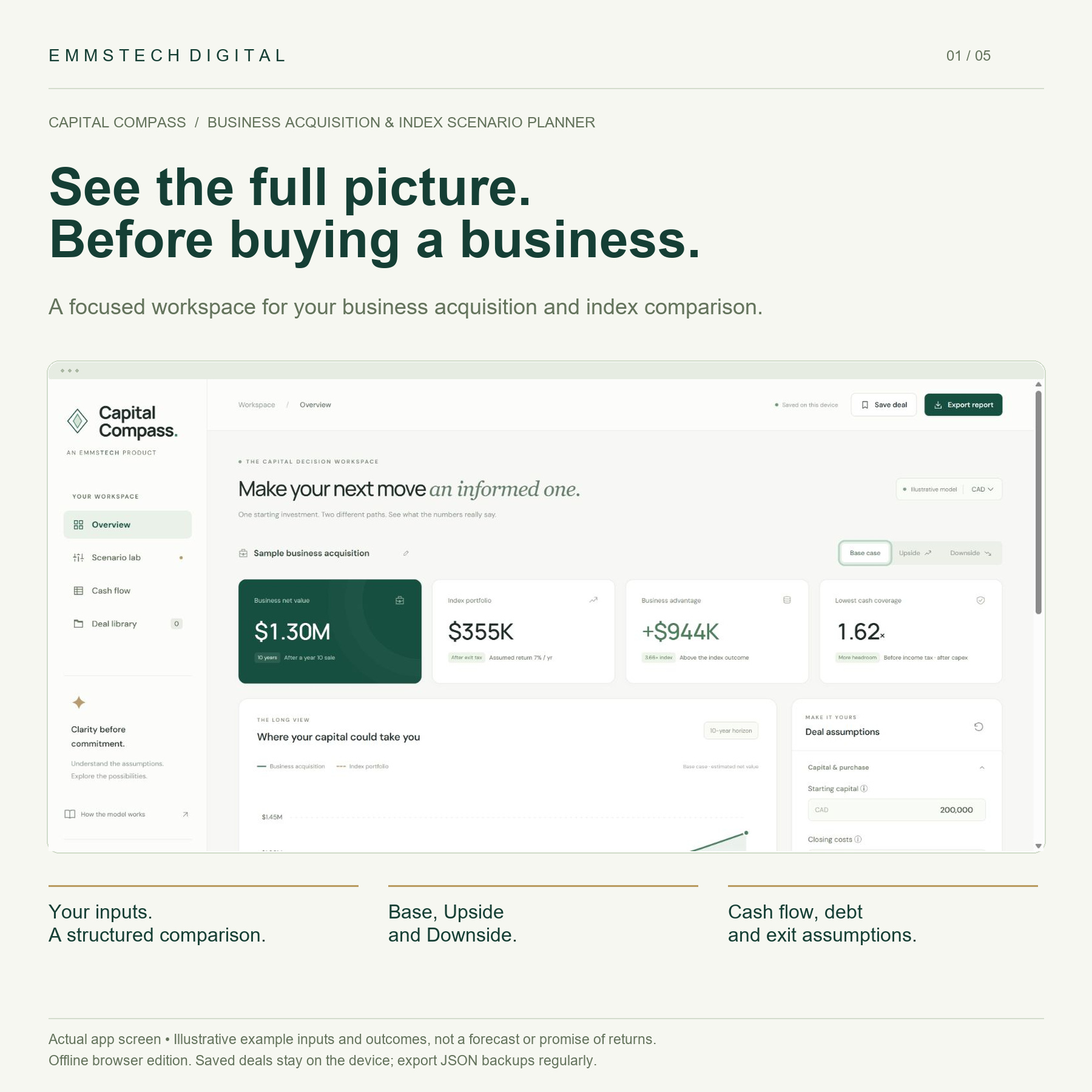
Try it yourself: Capital Compass — Business Acquisition & Index Scenario Planner lets you compare base, upside and downside cases, inspect annual cash flow, and export a report using your own assumptions. The offline app is available for Windows and Mac browsers.